
For a veteran who has spent months waking from nightmares, a drink can feel like the only way to get some sleep. For someone living with chronic pain or struggling after leaving the military, substance use may bring a few hours of relief or a sense of belonging. Those needs are real, even as tolerance, withdrawal, and disrupted sleep can make them harder to manage. SAMHSA estimated that 2.8 million U.S. veterans had a substance use disorder in the prior year in its 2023 survey. [1]
For some veterans, that pattern develops into a substance use disorder. SAMHSA estimated that 2.8 million adult U.S. veterans (14.0%) had a substance use disorder in the past year in its 2023 national survey. About 2.3 million veterans with a disorder received no substance use treatment that year. [1]
Recovery is easier to pursue when the reasons for using are taken seriously. A veteran may need help sleeping, treatment for pain or trauma, a safe place to live, or someone who will follow up after a referral. Those needs can be part of the same plan. At first contact, ask what the client is going through that self-medicating is soothing, and what they most want to change. That conversation can open a path to assessing immediate risk, offering treatment for substance use and trauma together, and making a plan the veteran can use when they leave your office.
PTSD triggers and self-medication
Post-traumatic stress disorder (PTSD) can bring intrusive memories, nightmares, avoidance, changes in mood or beliefs, and a heightened sense of threat. A smell, fireworks, an anniversary, a crowded room, or the feeling of being cornered can set off a response. Combat is one source of trauma. Military sexual trauma, training accidents, loss, and experiences before or after service also matter. Ask permission to discuss trauma, explain the limits of confidentiality, and let the veteran decide how much to share. [3, 5]
Short-term relief can reinforce use. If drinking quiets distress tonight, the urge to drink can get stronger the next time distress returns. Over time, disrupted sleep, rebound anxiety, and withdrawal can feed the cycle. Ask about pain, sleep, head injury, depression, isolation, and the loss of routine or community after service. Then help the veteran identify safer ways to meet the specific need that using has served. [5]
How many veterans are affected?
In the 2023 National Survey on Drug Use and Health, an estimated 2.8 million adult U.S. veterans (14.0%) met criteria for a past-year substance use disorder. An estimated 2.3 million veterans with a substance use disorder received no substance use treatment that year. Past-year prevalence was 21.2% among veterans ages 18–49 and 11.9% among those 50 or older. [1]
More recent national veteran survey data from 2025–2026 put probable past-year alcohol use disorder at 12.1% and past-month PTSD at 7.3%. These estimates come from separate analyses with different measures and time windows. They describe two conditions that can overlap. [3, 4]
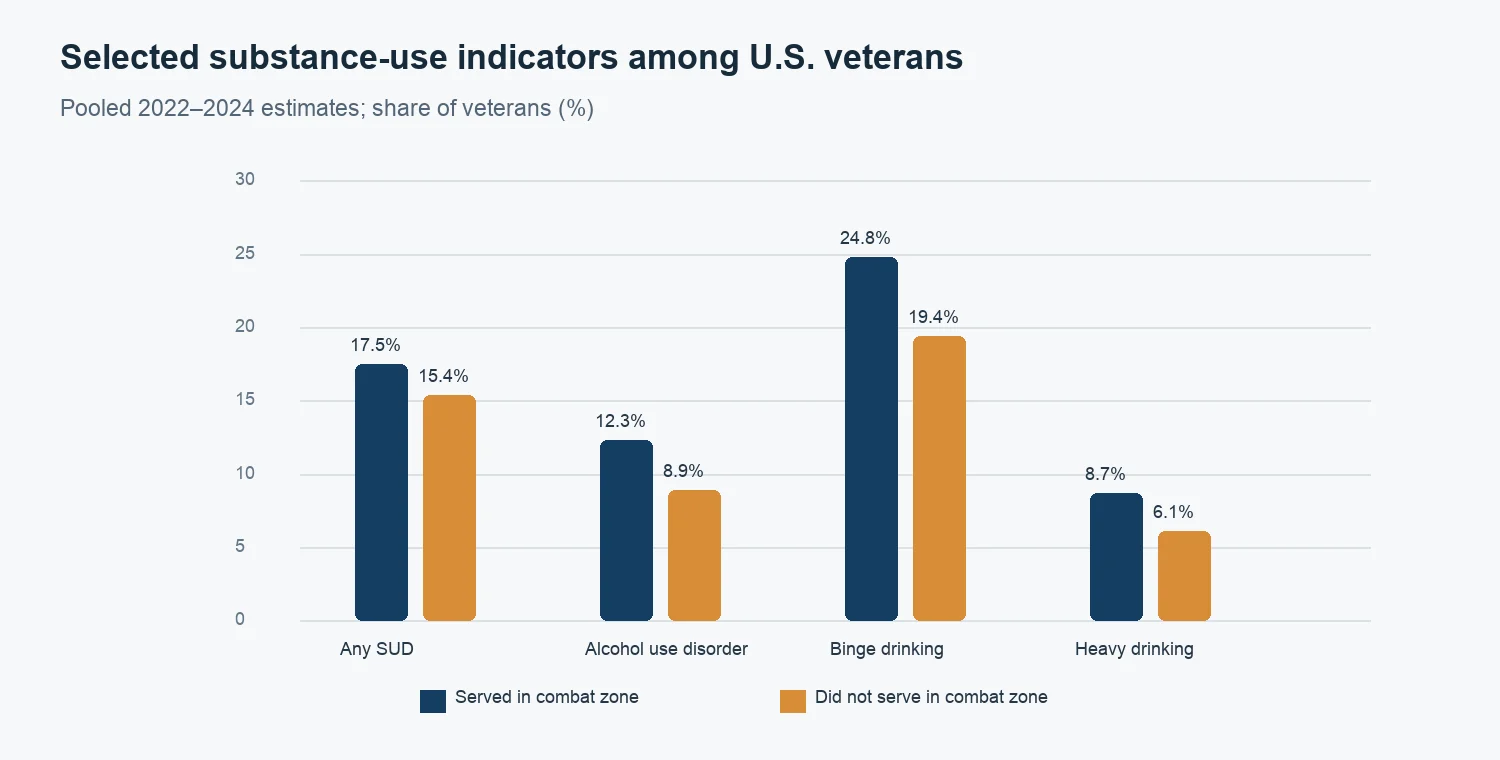
In SAMHSA’s pooled 2022–2024 survey, veterans who had served in a combat zone reported higher rates of alcohol use disorder, binge drinking, and heavy drinking. The difference in overall substance use disorder was statistically inconclusive. The survey covered U.S. veterans ages 18 and older in the civilian, noninstitutionalized population. Combat-zone service records where someone served and cannot establish what they experienced or what caused a disorder. [2]
First-contact checklist
- Ask permission. Explain confidentiality and ask if it is a good time to talk about alcohol or other substance use.
- Listen for what use helps the veteran manage. Acknowledge the need for relief and ask what the veteran wants to change.
- Check immediate safety. Ask about last use, overdose or withdrawal seizures, suicidal thoughts, and where the person will sleep tonight. For suspected opioid overdose, call 911 and give naloxone if available. Arrange urgent medical assessment for possible severe alcohol or benzodiazepine withdrawal. [6, 7]
- Offer options. Discuss the veteran’s preferences and what they can access. Ask which option feels workable today. Use tools such as AUDIT-C and PC-PTSD-5 when appropriate and follow positive screens with clinical assessment. [5, 6]
- Make a same-day connection when possible. With permission, call the receiving provider together. If VA payment is expected, confirm authorization and coverage for community care. [11]
- Agree on follow-up. Name who will reach out, when, and by what method. Address transportation, phone access, and medication supply. Agree on a backup if the referral falls through.
Treatment for PTSD and substance use
Choose the level of care around withdrawal risk, medical and psychiatric needs, daily functioning, housing, and the veteran’s goals. VA and community options include outpatient counseling and medication, intensive outpatient care, opioid treatment programs, medically managed withdrawal when indicated, and residential rehabilitation. Arrange ongoing care before a transition or discharge. [6]
When PTSD and substance use disorder co-occur, offer evidence-based care for both. Options include Prolonged Exposure (PE), Cognitive Processing Therapy (CPT), and Eye Movement Desensitization and Reprocessing (EMDR) alongside substance use treatment. COPE combines Prolonged Exposure with relapse-prevention skills in one protocol. Research more consistently shows improvement in PTSD symptoms. Substance use outcomes vary. Manage acute risks and work with the veteran to choose a treatment sequence they can participate in. [5]
Match substance use treatment to the disorder and the veteran’s preferences. Cognitive behavioral and motivational approaches can help. Contingency management has the strongest behavioral evidence for stimulant use disorder. For alcohol use disorder, options include naltrexone and acamprosate. For opioid use disorder, buprenorphine and methadone reduce overdose risk, and extended-release naltrexone is another option for appropriate patients. Offer naloxone and overdose education when opioid exposure is possible. Access to buprenorphine should continue even if counseling is unavailable or the patient declines it. [6, 7, 8]
Support between visits.
Some veterans value talking with people who understand military life. Others prefer a mixed group, a mutual-help meeting, or structured activities outside treatment. Invite a trusted friend or family member when the veteran wants their involvement.
- Plan for the next difficult moment. Identify a likely trigger, a person to call, a place to go, and a way to get there.
- Coordinate and track progress. With consent, name one person to coordinate across the treatment team, prescriber, peers, and housing staff. Track the veteran’s priorities, such as better sleep, attending work, or reconnecting with family. [5]
- Reconnect after a return to use. Reassess suicide and overdose risk and revise the plan. Opioid tolerance can drop during a break from use, increasing overdose risk. [7]
Housing and access to care.
On one night in January 2025, HUD counted 32,495 veterans experiencing homelessness, including 13,518 who were unsheltered. Housing instability can disrupt sleep, safe medication storage, telehealth privacy, and attendance at treatment. Ask about tonight’s housing early and pursue a stable placement alongside care. [9]
Match the referral to the need. VA’s Health Care for Homeless Veterans program can connect people to emergency or interim shelter. Grant and Per Diem supports transitional housing. Supportive Services for Veteran Families helps prevent homelessness and rapidly rehouse eligible households. HUD–VASH combines long-term rental assistance with VA case management. Availability and eligibility vary locally. [9]
Some veterans who are ineligible for VA health care can still qualify for specific VA or Vet Center services. Check the service’s eligibility rules while arranging a community option if needed. VA reported 6,488 veteran suicide deaths in 2024. Of those veterans, 62% had received no VA health care in the year of death or the previous year, underscoring the role of community providers. [11]
Before a recovery housing referral:
- Confirm the placement. Verify an available bed, total cost, physical accessibility, and transportation to treatment.
- Protect continuity of care. Confirm that prescribed medications can continue, and check where the veteran can connect privately if using telehealth. [10]
- Plan for disruptions. Ask who responds after hours, what happens after a return to use, and which backup placement is available if needed.
Nobody Heals Alone.
The short film Nobody Heals Alone can start a conversation about trauma, isolation, and asking for help. Preview it before a staff huddle or peer group, make viewing optional, and allow people to step out. Ask: “What made it easier or harder for the person to ask for help?”
Loading the player connects your browser to YouTube.
Watch Nobody Heals Alone on YouTube
Free Help and Referral Options.
- Immediate danger or crisis. For a medical emergency or immediate danger, call 911. The free, confidential Veterans Crisis Line is available 24/7, including for veterans who are outside VA care. Call 988 and press 1, text 838255, or chat with the Veterans Crisis Line.
- VA treatment. Use the VA substance use treatment page to find a program or ask your VA medical center for its substance use clinic. Eligibility and costs for ongoing care vary. In Palm Beach County, call West Palm Beach VA Behavioral Health at 561-422-8234.
- Community treatment referrals. The SAMHSA National Helpline provides free referrals 24/7 at 1-800-662-4357 in English and Spanish. Text your ZIP code to 435748 for English-language referrals, or search FindTreatment.gov. Ask about state-funded and sliding-scale care.
- Housing help. Call 877-424-3838, 24/7, for the National Call Center for Homeless Veterans. A veteran, family member, or referring provider can call.
- Readjustment and military sexual trauma. Call 877-927-8387 for Vet Centers, which offer confidential, no-cost readjustment counseling for eligible people. For free treatment of conditions related to military sexual trauma, ask a VA facility for its military sexual trauma coordinator.
- Peer and self-guided support. VetChange is a free online tool for veterans and service members concerned about drinking. SMART Recovery offers free meetings, including some for veterans and military communities.
References.
- SAMHSA 2023 NSDUH veteran estimates and treatment gap
- SAMHSA 2022–2024 veteran data spotlight and chart
- Pietrzak et al. (2026), National Trends in PTSD Among U.S. Veterans
- Goodwin et al. (2026), Probable Alcohol Use Disorder in U.S. Veterans
- VA National Center for PTSD, treatment of co-occurring PTSD and SUD · PC-PTSD-5 screening
- VA/DoD substance use disorder guideline and screening tools
- SAMHSA overdose prevention and response · ASAM alcohol withdrawal guidance · ASAM benzodiazepine tapering guidance
- ASAM/AAAP stimulant use disorder guideline · SAMHSA buprenorphine access guidance
- VA January 2025 veteran homelessness count · VA housing program quick guide
- VA guidance on telehealth for PTSD
- VA 2026 Veteran Suicide Prevention Annual Report release · VA eligibility with an other-than-honorable discharge · VA authorization for community care